
How to Build Finger Independence During Early Piano Practice
A piano keyboard offers endless possibilities, but in the beginning, you will soon discover that it’s easier to play the wrong notes than to control the fingers. Most beginners find that finding the correct keys is easier than getting each finger to play smoothly. Finger independence is a learned technique; it won’t happen without conscious practice and careful listening. Rather than focus on playing fast, slow down and listen to each finger as it strikes the key and pay attention to how the hand glides across the keys.
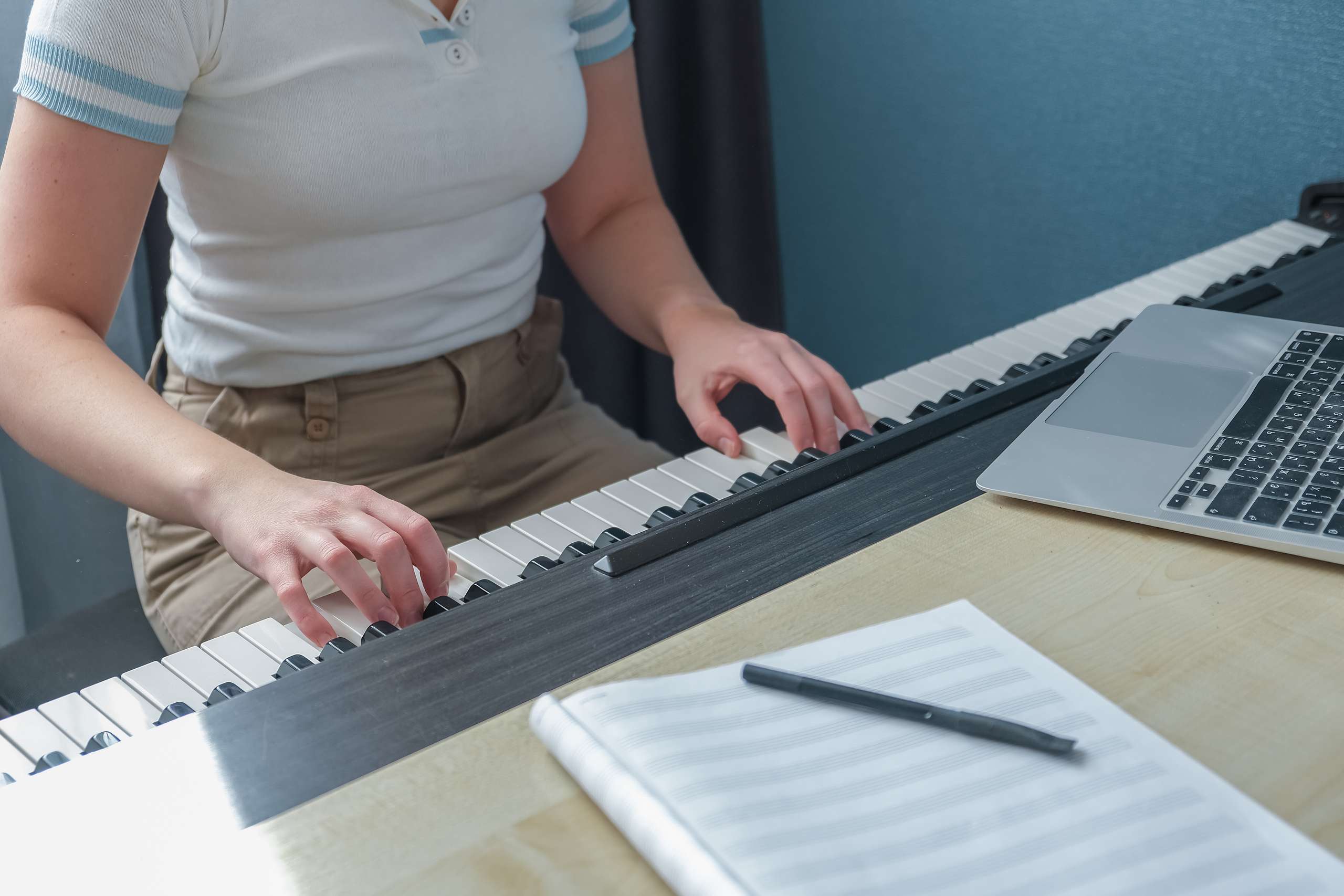
Sit comfortably at the piano with your forearms at the same height as the keys and relaxed wrists. Place all five fingers on five consecutive keys and play each key, one by one, from left to right slowly. This is not a speed drill, but a technique-building exercise. Each key should be depressed smoothly without lifting or collapsing the hand. As you practice this exercise, listen for fingers that play more forcefully than others or if your wrist clenches when you play with your fourth and fifth fingers. Eliminating these tendencies as soon as you notice them will prevent problems later on.
One of the most common tendencies is to have the fourth and fifth fingers lag behind the others. This usually occurs because you are using too much force and stiffening the hand as you attempt to push your fourth and fifth fingers down. Instead of using more force, slow down and allow the key to drop with the weight of your finger. Try to think of placing your fingers on the keys rather than striking the keys. If you feel tension building, stop, release your hand, and begin the exercise again. This exercise isn’t about developing finger strength, but about developing good finger habits.
It is more productive to practice for short periods of time with focused attention than to practice for extended periods of time with divided attention. Practice this exercise about 15 minutes a day. Play the five note pattern going up the keyboard and then coming back down. Play smoothly and evenly. After a few repetitions, try altering the rhythm a bit by holding one note a little longer than the others before playing the next note. This forces your hand to maintain its shape instead of moving quickly to the next note. Once this exercise becomes easy, transpose it to a different key so that the fingers have to adjust to a new distance between the keys.
Carefully listening to your playing will enable you to get the most out of this exercise. If each note sounds evenly and your hand feels secure, you are well on your way to successfully playing the piano. Your fingers will no longer fight the piano, but will learn to play with ease. Eventually, this will enable you to play melodies smoothly because each finger will learn how to function within a sequence. Even the most mundane sounding exercises can become invaluable with the right attitude, persistence, and attention.